Does Intermittent Fasting Lower PSA Levels? What the Evidence Actually Says
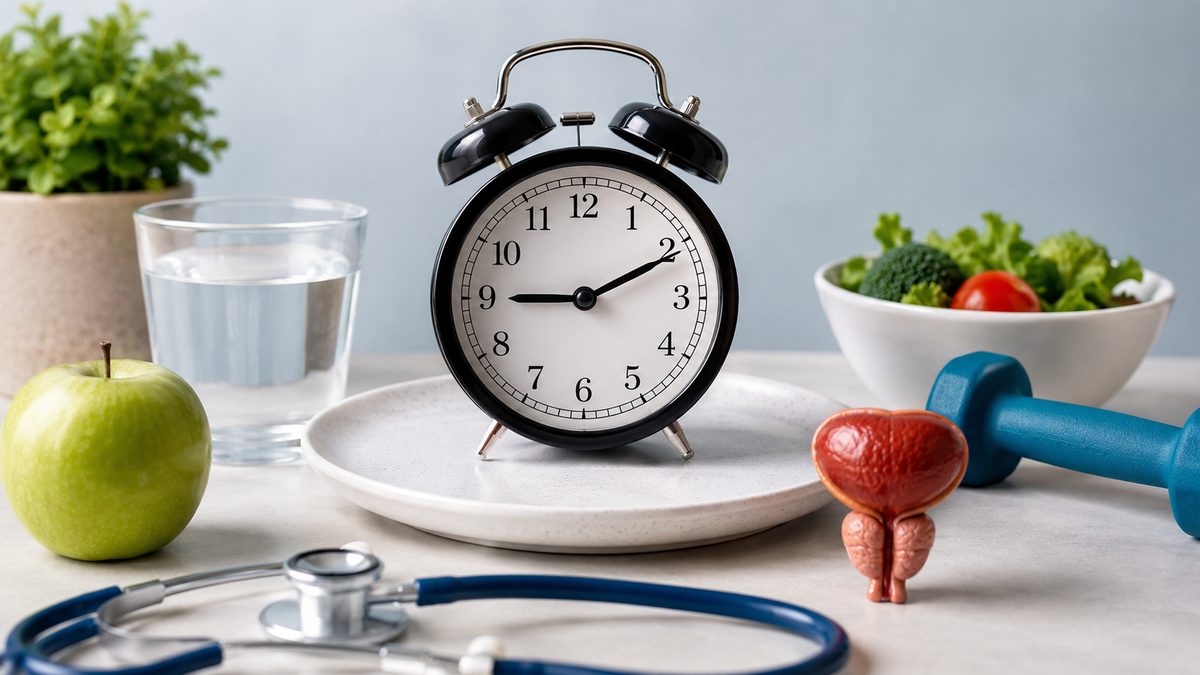
Short-term fasting doesn't meaningfully change your PSA levels. A population study examining fasting time and serum PSA found no clinically significant relationship between how long you fast and what your PSA reads. Standard PSA testing guidelines don't require fasting at all.
If you're doing intermittent fasting and wondering whether it'll skew your results or improve your prostate health, the honest answer is: probably not in the way you're hoping.
That said, there's a more interesting story underneath. Weight loss, inflammation, and metabolic health do connect to PSA in ways that matter. And if you're tracking PSA over time, consistency in your testing conditions matters more than whether you fasted that morning.
What Actually Causes PSA Levels to Rise?
PSA stands for prostate-specific antigen. It's a protein produced by prostate tissue, and your blood level rises when something disrupts that tissue. The disruption can be benign or serious.
Common causes of elevated PSA include:
- Benign prostatic hyperplasia (BPH), an enlarged prostate that isn't cancerous but still produces more PSA
- Prostatitis, inflammation or infection of the prostate, which can spike PSA significantly
- Prostate cancer, the reason most men get tested
- Recent ejaculation, can temporarily raise PSA for up to 48 hours
- Vigorous exercise, particularly cycling or anything that puts pressure on the perineum
- Digital rectal exam (DRE), physical manipulation of the prostate raises PSA short-term
- Urinary tract infections, inflammation spreads to prostate tissue
PSA is organ-specific but not cancer-specific. That distinction matters. A high PSA tells you something's happening with your prostate. It doesn't tell you what.
This is why context, trends over time, and additional testing all matter more than a single number.
How Does Intermittent Fasting Affect Prostate Health?
fasting doesn't directly target the prostate. What it does is reduce systemic inflammation, improve insulin sensitivity, and in many men, drive meaningful weight loss. Each of those has a downstream effect on prostate health.
Chronic inflammation drives prostate tissue disruption. When inflammation drops, PSA can follow. But this is slow, measured in months, not something that happens because you skipped breakfast before your blood draw.
PSA is more sensitive to metabolic changes than most men realize. The glycosylation of PSA molecules, essentially how sugar molecules attach to the protein, differs between benign and malignant prostate tissue. Genetic variants can alter PSA glycosylation, which changes both the stability of the protein and its measured concentration in blood.
This tells us PSA isn't a static, simple marker. It responds to your body's metabolic environment.
Intermittent fasting changes that environment. Whether those changes are large enough to move PSA in a clinically meaningful way hasn't been directly studied. The honest position: the mechanism is plausible, but the evidence isn't there yet.
Can Weight Loss Reduce PSA Levels?
Yes. And this is where intermittent fasting has its strongest indirect case.
Excess body fat, particularly visceral fat, drives chronic low-grade inflammation and elevates estrogen relative to testosterone. Both affect prostate tissue. Men who lose significant weight often see PSA levels drop, especially if they started obese.
If intermittent fasting helps you lose weight, and for many men it does, because it reduces total caloric intake without requiring calorie counting, then it may contribute to lower PSA over time through that pathway. But the fasting itself isn't the mechanism. The weight loss is.
This distinction matters if you're trying to manage PSA. Fasting as a tool for weight loss makes sense. Fasting as a direct PSA intervention doesn't have evidence behind it.
What Foods Can Naturally Lower PSA Levels?
Diet does influence PSA, and some foods have more evidence than others.
Tomatoes and lycopene. Lycopene is a carotenoid found in cooked tomatoes. Multiple studies link higher lycopene intake with lower PSA levels and reduced prostate cancer risk. Cooked tomatoes, tomato paste, sauce, and soup deliver more usable lycopene than raw.
Cruciferous vegetables. Broccoli, cauliflower, Brussels sprouts, and kale contain sulforaphane and indole-3-carbinol, compounds that support healthy cell turnover in prostate tissue. Men who eat these regularly tend to have better inflammatory markers.
Green tea. Epigallocatechin gallate (EGCG) in green tea has shown anti-inflammatory effects on prostate tissue in several studies. The effect is modest, but consistent.
Fatty fish. Omega-3 fatty acids from salmon, sardines, and mackerel reduce systemic inflammation. Lower inflammation means lower PSA over time.
Foods to reduce: Processed red meat, high-fat dairy, refined carbs, and alcohol are all linked to higher inflammatory markers and, in some studies, higher PSA. Cutting these tends to help more than adding any single superfood.
Should Men With High PSA Try Intermittent Fasting?
If you have elevated PSA and your doctor is monitoring it, intermittent fasting is unlikely to hurt and may help. But not for the reason most people assume.
The case for trying it:
- It's an effective tool for weight loss in men who struggle with calorie restriction
- Weight loss reduces inflammation, which can lower PSA over months
- It improves insulin sensitivity, which matters for prostate health
- It doesn't interfere with PSA testing accuracy
The case against expecting too much:
- No study has shown intermittent fasting directly lowers PSA
- If your PSA is rising due to cancer, fasting won't stop that
- Dietary changes take months to show up in PSA trends
What I'd tell any man in this situation: use intermittent fasting as part of a broader metabolic health strategy, not as a substitute for medical follow-up. Keep your testing schedule. Don't skip a PSA check because you've been fasting and hope the number will be better.
One Thing Most Articles Get Wrong About PSA and Fasting
Most articles frame this as: will fasting before my blood test change the result? That's the wrong question.
The better question is: what testing conditions should I keep consistent so my PSA trend is readable over time?
PSA is most useful as a trend, not a single number. A PSA of 3.5 means very little on its own. A PSA that's gone from 2.1 to 3.5 over 18 months means something. A PSA that's stayed at 3.5 for three years means something different.
To make that trend readable, you need consistent conditions. Same time of day. No ejaculation in the 48 hours prior. No vigorous exercise the day before. No prostate exam immediately before the draw. Whether you ate breakfast matters far less than these factors.
If you do intermittent fasting regularly, just test in your normal fasted state every time. Consistency is the goal.
The PSA Biomarker Is More Complex Than Most Men Know
Here's something most articles skip: PSA isn't one thing. It exists in multiple molecular forms, free PSA, complexed PSA, proPSA, and others, and the ratio between these forms carries diagnostic information that total PSA alone misses.
Newer research is looking at PSA glycosylation as a way to distinguish benign from malignant prostate tissue more accurately. The sugar molecules attached to PSA differ depending on whether the tissue producing it is healthy or cancerous. This is a promising direction for reducing unnecessary biopsies.
Genetic variants also affect PSA levels independently of prostate health. A specific SNP (rs61752561) creates an extra glycosylation site on PSA, which alters how stable the protein is and how much shows up in blood. This means two men with identical prostate health can have different PSA readings based on genetics alone.
The practical takeaway: if your PSA is borderline or confusing, ask your doctor about free-to-total PSA ratio or newer kallikrein panel tests. Total PSA alone has real limitations.
FAQ
Does fasting before a PSA test change the result?
No. Short-term fasting of 8 to 12 hours doesn't meaningfully affect PSA levels. Standard guidelines don't require fasting before a PSA test. The factors that matter are avoiding ejaculation, intense exercise, and prostate manipulation for 48 hours beforehand.
How long does it take for PSA to drop after lifestyle changes?
Typically three to six months before you see a meaningful shift. PSA responds to sustained changes in inflammation and weight, not short-term interventions. Test at your regular interval and look for trends over 12 to 24 months.
Can a high-fat meal raise PSA before a test?
There's no strong evidence that a single meal changes PSA in a clinically significant way. The variables that move PSA short-term are physical: ejaculation, exercise, prostate exam. Not dietary.
Is intermittent fasting safe for men with prostate cancer?
This depends on the stage of cancer, treatment status, and overall health. Some research on caloric restriction and cancer is promising, but men undergoing active treatment should discuss any dietary changes with their oncologist first.
What PSA level should I be worried about?
There's no universal threshold. A PSA above 4.0 ng/mL is often flagged, but context matters more than the number. Age, prostate size, rate of change over time, and free-to-total PSA ratio all factor in. A rising PSA in a younger man is more concerning than a stable PSA of 5.0 in a man in his 70s.
Does intermittent fasting reduce prostate inflammation?
Indirectly, yes. Intermittent fasting reduces systemic inflammatory markers in most people who sustain it. Lower systemic inflammation can reduce prostate inflammation over time. But this is a slow, indirect effect, not a targeted prostate treatment.
What to Do Now
- Get a baseline PSA and track it over time. One number tells you almost nothing. A trend tells you everything. Book the test, record the result, and retest at the interval your doctor recommends.
- Standardise your testing conditions. Same time of day, no ejaculation or intense exercise for 48 hours prior, no prostate exam immediately before the draw. Do this every time.
- Use intermittent fasting for weight loss if it suits you, not as a direct PSA intervention. If it helps you lose weight and reduce inflammation over months, your PSA may reflect that. Don't expect a quick fix.
- Shift your diet toward anti-inflammatory foods. More cooked tomatoes, cruciferous vegetables, fatty fish, and green tea. Less processed meat, refined carbs, and alcohol. These changes compound over time.
- Talk to a doctor who specialises in men's health if your PSA is elevated or rising. Diet and lifestyle matter, but they work alongside medical monitoring, not instead of it.

Sources
- Naugler C, Lau C, Guo M, Viczko J (2014) "A population study of fasting time and serum prostate-specific antigen (PSA) level" Asian Journal of Andrology. DOI: 10.4103/1008-682x.125912
- Ferro M, Buonerba C, Terracciano D, Lucarelli G, Cosimato V, Bottero D, et al. (2016) "Biomarkers in localized prostate cancer" Future oncology (London, England). PMID: 26768791
- Halldórsson S, Hillringhaus L, Hojer C, Muranyi A, Schraeml M, Lange MS, et al. (2024) "Development of a first-in-class antibody and a specific assay for α-1,6-fucosylated prostate-specific antigen" Scientific reports. PMID: 39020051
- Srinivasan S, Stephens C, Wilson E, Panchadsaram J, DeVoss K, Koistinen H, et al. (2019) "Prostate Cancer Risk-Associated Single-Nucleotide Polymorphism Affects Prostate-Specific Antigen Glycosylation and Its Function" Clinical chemistry. PMID: 30538125

What snack is filling but not fattening?
Read article →
What can I eat that will fill me up but is healthy?
Read article →
How to reduce MS symptoms?
Read article →
Can fasting help autoimmune disorders?
Read article →
Does fasting help male fertility?
Read article →