Which is Better, 14/10 or 16/8 Fasting? A Direct Comparison
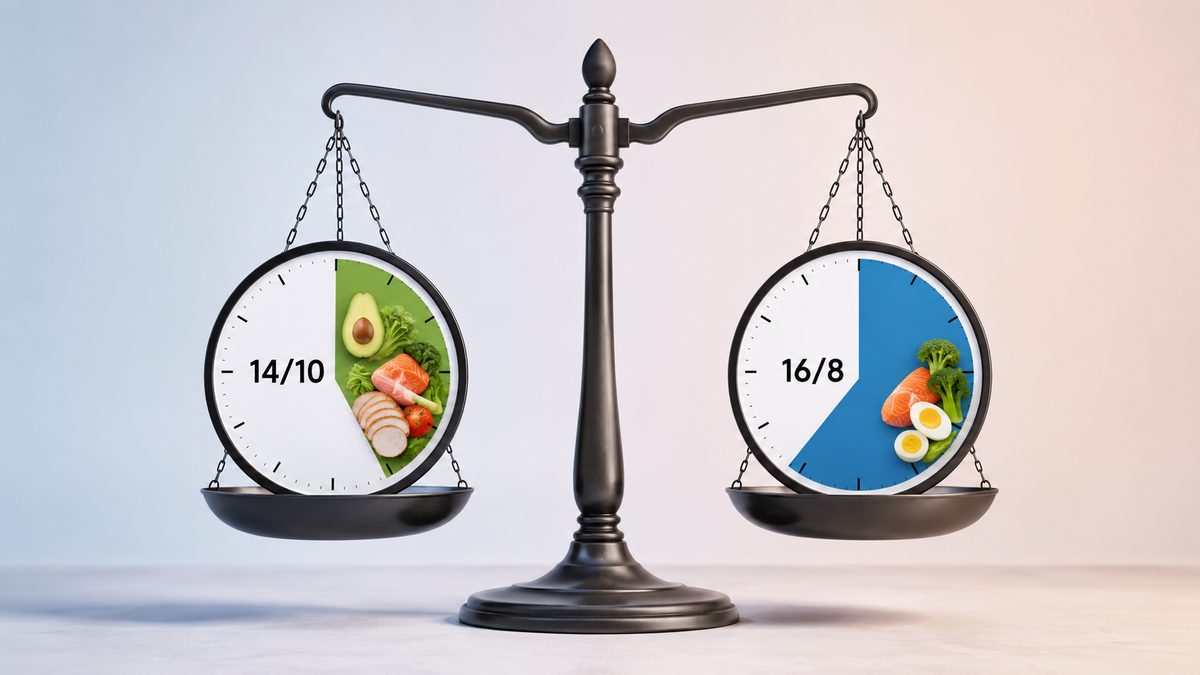
For most people, 14/10 and 16/8 fasting produce similar weight loss and metabolic improvements. That extra two hours probably won't decide your results. What will is whether you can stick to the schedule consistently. The best fasting window is the one you can actually follow every day without wrecking your sleep, your social life, or your energy levels.
That said, 16/8 does carry a small physiological edge. A longer fast gives your body more time to deplete glycogen stores and shift toward fat burning. If you can handle 16 hours comfortably, it's worth doing. But if 16/8 leaves you ravenous and you overeat during your window, 14/10 will outperform it every time. Adherence beats protocol. metabolic shift
What is the difference between 14/10 and 16/8 intermittent fasting?
Both are forms of time-restricted eating (TRE), where you compress all your meals into a set window each day. With 14/10, you fast for 14 hours and eat within a 10-hour window. With 16/8, you fast for 16 hours and eat within 8 hours. In practice, the difference is roughly skipping breakfast an hour or two later, or finishing dinner an hour or two earlier.
The mechanism is the same. When you go without food long enough, your body burns through its stored glucose (glycogen) and begins producing ketones from fat. This metabolic shift is associated with improved insulin sensitivity, lower inflammation, and fat loss. The question is whether 14 hours is long enough to trigger that shift reliably, or whether you need 16.
Most people hit the glycogen-depletion window somewhere between 12 and 16 hours depending on their activity level, metabolic rate, and what they ate the night before. A sedentary person who ate a large carbohydrate-heavy dinner may not fully deplete glycogen at 14 hours. An active person who ate lightly might get there at 12. There's no universal threshold, which is part of why the research doesn't show a dramatic gap between the two windows.
Is 16/8 fasting more effective for weight loss than 14/10?
Probably by a small margin, but not enough to matter if 16/8 is harder for you to maintain. A 2025 network meta-analysis of 99 randomised trials covering 6,582 adults confirmed that intermittent fasting including TRE improves body weight and cardiometabolic markers, but it didn't isolate specific windows like 14/10 versus 16/8. No large head-to-head trial has directly compared these two schedules.
What the broader evidence shows is that TRE in general produces weight loss of 1 to 8 percent of starting body weight and reduces calorie intake by 10 to 30 percent without requiring people to count calories. A 2022 randomised clinical trial found that early TRE (eating from 7am to 3pm, a 16/8 structure) outperformed a 12-plus-hour eating window even when both groups ate fewer calories, suggesting the fasting duration itself adds benefit beyond calorie restriction alone.
The weight loss difference between 14/10 and 16/8 in practice comes down to two things: how much you eat during your window, and how consistently you follow the schedule. A 2021 review confirmed that adherence is the dominant variable across all intermittent fasting protocols. If 16/8 causes you to binge during your eating window because you're too hungry, you'll likely do better on 14/10.
Which fasting schedule is easier for beginners, 14/10 or 16/8?
14/10 is easier to start with. And starting easier usually means you actually start. A 10-hour eating window is close to what many people already do without thinking about it. If you finish dinner at 7pm and eat breakfast at 9am, you're already doing 14/10. That familiarity reduces the psychological friction that causes most people to quit fasting protocols in the first two weeks.
The practical recommendation is to run 14/10 for two to four weeks first. Get comfortable with the rhythm, learn how your hunger patterns shift, and confirm your energy holds up during the fast. Then extend to 16/8 if you want to push further. Most people see weight loss and improved energy within two to four weeks on either schedule, with more pronounced metabolic changes appearing over eight to twelve weeks.
Jumping straight to 16/8 when you've never fasted before often leads to headaches, irritability, and poor concentration in the first week. These symptoms usually pass, but they're also the main reason beginners quit. Starting at 14/10 lets your body adapt to fat-burning metabolism gradually.
Can women benefit more from 14/10 fasting compared to 16/8?
This is one of the angles most fasting articles get wrong. The common claim is that women should always use shorter fasting windows because longer fasts disrupt hormones. The evidence for this is thinner than the internet suggests.
What's true is that some women, particularly those who are lean, highly active, or in perimenopause, report disrupted sleep, increased cortisol, and irregular cycles when fasting aggressively. These responses are real and worth taking seriously. But they're not universal, and they're not exclusive to 16/8. A woman who is overweight, sedentary, or insulin resistant may respond very well to 16/8 with no hormonal disruption at all.
The umbrella review of 130 studies found that intermittent fasting generally improved metabolic function across populations, though the TRE-specific studies had small sample sizes and short durations, making it hard to draw firm sex-specific conclusions. A 2024 umbrella review of 153 studies similarly found broad metabolic benefits from TRE but didn't report sex-stratified outcomes for specific windows.
The practical answer is that women who are new to fasting, who have a history of disordered eating, or who are trying to conceive should start with 14/10 and monitor how they feel. Women who are primarily focused on fat loss and metabolic health and have no hormonal concerns can trial 16/8 without assuming it will cause problems. Pay attention to sleep quality, energy, and cycle regularity as your leading indicators.
Does 16/8 fasting offer better metabolic benefits than 14/10?
On paper, yes. In practice, the gap is small for most people. The metabolic benefits of TRE that the research consistently documents include lower fasting blood glucose, improved insulin sensitivity, reduced blood pressure, better cholesterol profiles, and lower oxidative stress markers. These benefits appear across fasting windows ranging from 14 to 20 hours, which suggests the threshold for triggering them is somewhere below 14 hours for most people.
A 2022 review found that TRE with an eating window as short as 6 hours (18/6) produced weight loss and improved cholesterol and blood pressure, but noted the need for longer-term research to confirm durability. A 2023 review found that TRE improved body composition and lowered fasting blood glucose and insulin, though the studies were short and varied in design.
When I extended from 14/10 to 16/8, the most noticeable change was in morning energy and mental clarity, not dramatic weight loss. That tracks with what the research suggests: the metabolic shift to fat burning and ketone production becomes more consistent at 16 hours, which some people experience as sharper focus and steadier energy. Whether that translates to meaningfully better long-term outcomes compared to 14/10 isn't yet established by direct comparison trials.
One thing the research does agree on is that when you eat matters as much as how long you fast. Early TRE, finishing meals by early afternoon, aligns with your body's circadian insulin sensitivity and produces better glucose handling than the same fasting window shifted to late in the day. This applies to both 14/10 and 16/8. Eating your last meal at 6pm and breaking your fast at 8am (14/10) will likely outperform eating your last meal at 10pm and breaking your fast at 2pm (16/8).
Which fasting method is better for people with busy or social schedules, 14/10 or 16/8?
14/10 is more flexible and easier to fit around a normal social life. A 10-hour eating window from, say, 9am to 7pm covers most social meals, work lunches, and family dinners without requiring you to explain why you're not eating. 16/8 with an 8-hour window from noon to 8pm works well for many people but starts to create friction around morning meetings, early breakfasts, and late dinners.
The research on adherence consistently shows that social eating pressure and schedule variability are among the top reasons people abandon fasting protocols. A schedule you can maintain through a work trip, a birthday dinner, or a weekend away is worth more than a theoretically superior protocol you abandon every time life gets complicated.
If your schedule changes week to week, 14/10 gives you more room to adjust your window without breaking the fast entirely. If your schedule is predictable and you can reliably skip breakfast or finish dinner early, 16/8 is manageable and worth the extra metabolic push.
The question of which is better, 14/10 or 16/8 fasting, comes down to your specific situation rather than a universal ranking. Both work. Both are supported by the same body of evidence showing TRE improves weight, insulin sensitivity, blood pressure, and cholesterol. The two-hour difference is real but not decisive.
What to do if you're not losing weight on either schedule
If four weeks on either 14/10 or 16/8 hasn't moved the scale, the fasting window is almost certainly not the problem. The most common cause is eating too many calories during the eating window, often because hunger from the fast drives larger or higher-calorie meals. Fasting doesn't create a calorie deficit automatically. It creates conditions that make eating less easier for most people, but it doesn't override a surplus.
Check what you're drinking during the fast. Calories from milk in coffee, flavoured water, or protein shakes can blunt the metabolic shift and stall fat loss without you realising it. Black coffee, plain tea, and water are the only safe options during the fasting window.
Also check meal timing within your window. Eating your largest meal late in the evening, even within your eating window, works against your circadian metabolism. Shifting your bigger meals earlier in the day consistently improves glucose handling and fat loss outcomes.
FAQ
Can I switch between 14/10 and 16/8 on different days?
Yes. Consistency matters more than rigidity. If you do 16/8 on weekdays and 14/10 on weekends to accommodate social meals, you'll still get most of the benefit. What you want to avoid is abandoning the fast entirely on difficult days.
Do I need to eat differently during my eating window?
Fasting works best when your eating window contains whole foods, adequate protein, and reasonable portions. It doesn't require a specific diet, but eating ultra-processed food during your window will blunt the metabolic benefits regardless of how long you fast.
How long before I see results?
Most people notice changes in energy and appetite within one to two weeks. Measurable weight loss typically appears within two to four weeks. More significant metabolic improvements, like lower fasting glucose and better cholesterol, tend to show up over eight to twelve weeks of consistent practice.
Is it safe to exercise while fasting?
For most people, yes. Light to moderate exercise in a fasted state is well tolerated and may enhance fat burning. High-intensity training while fasted can cause dizziness or poor performance in some people, particularly beginners. If you train hard, consider scheduling workouts near the start of your eating window so you can refuel immediately after.
Does coffee break a fast?
Black coffee does not meaningfully break a fast. It contains negligible calories and may actually support fat oxidation. Adding milk, cream, or sugar does break the fast metabolically.
What if I get very hungry during the fasting window?
Hunger during the first one to two weeks is normal as your body adapts. Drinking water or black coffee usually helps. If hunger is severe and persistent beyond two weeks, you may be under-eating during your window. Increase protein and fibre at your last meal before the fast begins.
The one thing that matters most
Pick the window you can follow consistently for at least eight weeks and start tomorrow. If you're new to fasting, that's 14/10. If you've fasted before and want more metabolic benefit, try 16/8. Either way, focus on eating whole foods, finishing your last meal as early as your schedule allows, and not compensating for the fast by overeating. That combination will outperform any specific window choice every time.
Sources

What snack is filling but not fattening?
Read article →
What can I eat that will fill me up but is healthy?
Read article →
How to reduce MS symptoms?
Read article →
Can fasting help autoimmune disorders?
Read article →
Does fasting help male fertility?
Read article →